

 360° Virtual Tours
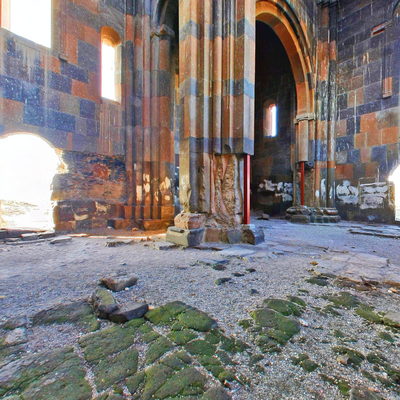


Memorial/Great Cathedral (Fethiye Mosque) According to inscriptions and historians, the foundations of the church were laid by Bagratid King Sembat II in 990 AD, but after King Sembat's death, his wife, Queen Katranide, completed the church in 1001. The architect of the church was Master Tiridat, who also repaired the Hagia Sophia Church in Istanbul in the same century.
The church has a cruciform plan, with the central area bordered by sturdy columns supporting arches. The semicircular apse is higher than the rest of the church and is decorated with sculptural niches. This style of decoration in the apse is a typical example of 11th-century church architecture. The basilical cross-plan building has three entrance doors: the western one is the public entrance, the northern one the patriarch's entrance, and the southern one the king's entrance. The church is illuminated by narrow, high arched windows. The facade walls of the church are divided by arches, which are connected by columns. The frescoes in the apse of the church are estimated to have been created in the 13th century. Built of red tuff stone, the cathedral sits on a stepped foundation, and its dome and bell tower, along with a portion of the northern wall, have been destroyed. After Sultan Alp Arslan conquered Ani in 1064, the cathedral was converted into a mosque, and the first conquest prayer was performed there. For this reason, the large cathedral is also called the Conquest Mosque (Fetihiye Cami).
Ani (Armenian: Անի, Latin: Abnicum) is an archaeological site located in the Central district of Kars, 48 km from the city center, along the Arpaçay River. Between 961 and 1045, it served as the capital of the Armenian rulers of the Bagratuni Dynasty. It also contains some examples of Islamic architecture from the 11th and 12th centuries.
The city's name first appears in the 6th century as a fortified place belonging to Armenian lords of the Gamsaragan dynasty. A long struggle between the Armenian Gamsaragan family and the Armenian Bagrationi (Bagrat) family ended with the victory of the latter, and in 780, the Gamsaragans sold their possessions to the Bagratids and migrated to Byzantium.
In 885, Ashot I of the Bagratid dynasty was recognized as "King of Armenia/Shahanshah of Armenia" by the Abbasid Caliph and the Byzantine Emperor. Ashot and his sons ruled first in Bagaran (located near Halimcan village, 8 km north of present-day Tuzluca district), then in Shirakavan (located in Koyucak area of Akyaka district), and finally in Kars city center. In 961, Ashot III (953-977) moved his capital to Ani and began the construction of a large city there. The city experienced its most glorious period during the reigns of Smpat II (977-989) and his son Gagik (989-1020). It is said that during this time, the city's population exceeded 100,000. After the Byzantines captured Ani in 1045 and ended the Bagratid state, the region, left defenseless and unsettled, surrendered to the Seljuk Sultan Alp Arslan in 1064.
After the Turkish conquest, the city remained under Byzantine rule until 1064, when it was conquered by the Seljuks. However, there is no evidence of a Seljuk administration being established in the city. Shortly after the Seljuk conquest, the city and its surroundings appear to have been under the rule of the Shaddadid principality, of Kurdish origin. The most important Islamic monument in Ani, the Menuchihr Mosque, was built in 1072 by the Shaddadid emir Menuchihr.
Around 1190, a Georgian bey named Zakare Mkhrgrdzeli established a dominion encompassing the Kars and Akhaltsikhe regions, using the Ani fortress as his base. His descendants ruled first as "atabey" (regent) under the Georgian kings in Tbilisi, and later under the Mongol Ilkhanids. Many of the Christian monuments in Ani were built or restored during this period. Although the city later came under the rule of the Jalayirid and Kara Koyunlu states, its population remained predominantly Armenian.
Ani suffered severe damage in the 1319 earthquake and was subsequently captured and destroyed by Timur. Despite this, it appears that a population continued to reside in the city until it was completely abandoned during the Ottoman-Persian war of 1535.
Historical
Venue Features
Activities
Similar places
Similar places, nearby places, and related routes are listed here as modular panels.
01
Hasankeyf
Batman · Southeastern Anatolia Region · Turkey
02
Gobekli Hill
Sanliurfa · Southeastern Anatolia Region · Turkey
03
Ulubey Canyon Glass Terrace
Usak · Aegean Region · Turkey
04
Bodrum - Ancient Theatre
Mugla · Aegean Region · Turkey
05
Hartapus Monument
Karaman · Central Anatolia Region · Turkey
06
Cappadocia Uchisar Bazaar
Nevsehir · Central Anatolia Region · Turkey
Nearby places
Similar places, nearby places, and related routes are listed here as modular panels.
Related routes
Travel plans that include this tour as a stop are listed here.
No matching content is available for this section.
Comments
2Sign in to leave a comment.
Sign inBizim atalaremezin topraklare!
Նունե Մովսիսյան