

 360° Virtual Tours
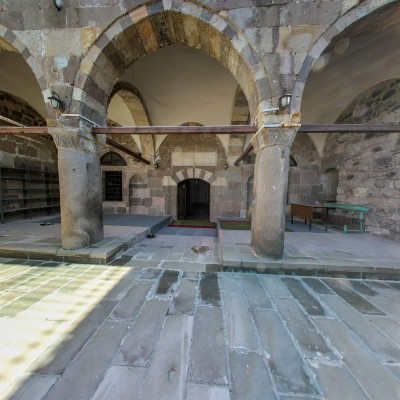
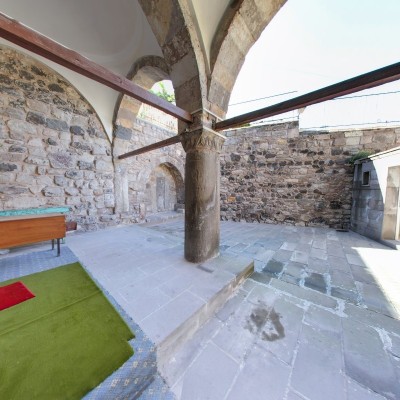
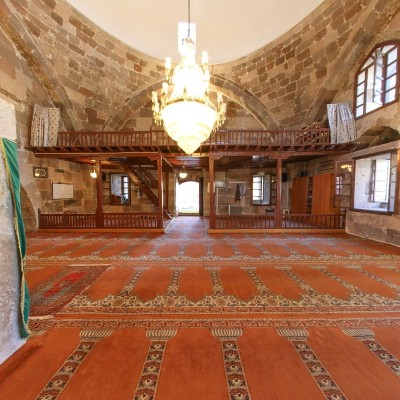
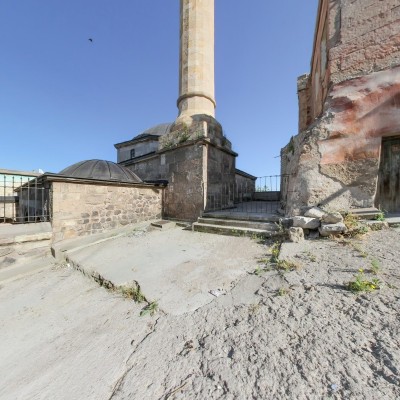
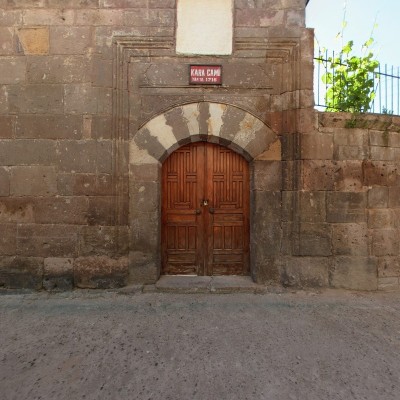
Located at the intersection of Eski Konak Street and Kara Camii Street in the Raşit Bey neighborhood of central Nevşehir, Kara Mosque is a significant historical structure built in 1716. Constructed using dressed stone and an alternating masonry technique, the mosque preserves the character of its era through its layout, inscriptions, stonework, and architectural features.
Situated within a courtyard, the mosque features a large marble inscription plaque above its low-arched courtyard entrance. The plaque, the surface of which shows signs of blistering due to moisture, bears a twelve-line inscription in Ottoman Turkish. Above the door leading to the main prayer hall, there is a second Ottoman Turkish inscription—arranged in four columns across seven lines—carved into dark-colored marble.
A three-bay portico (narthex) is located on the north side of the mosque. Formed by arches springing in two directions from two oval piers, each bay of this section is covered by a dome transitioning via pendentives. A staircase providing access to the minaret is located on the western wall of the portico.
The mosque’s minaret, featuring a square base and a cylindrical shaft, is notable for the floral ornamentation located beneath its gallery (*şerefe*). The minaret’s onion-shaped cap is another of Kara Mosque's distinctive architectural features.
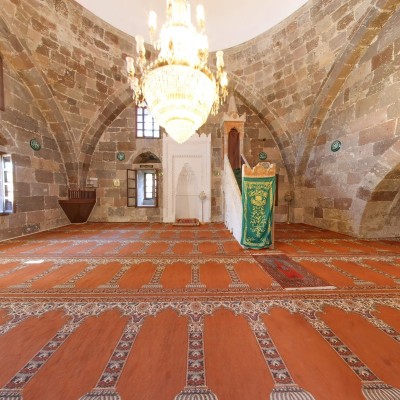
The main prayer hall (*harim*) has a roughly square plan and is covered by a dome resting on an octagonal drum, transitioning via pendentives. In the western section of the prayer hall, there is an *iwan* (a vaulted space open on one side) that extends beyond the square layout of the main hall.
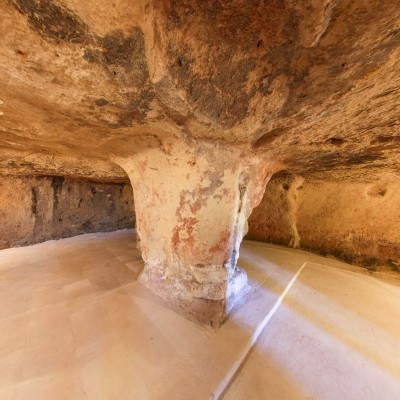
A doorway in the western wall of this *iwan* opens into another space significant to the history of Kara Mosque. From here, one passes into an irregularly shaped, rock-cut section that served as a small mosque (*masjid*) before the construction of the current mosque in 1716. This rock-cut space—which was used as a wood storage area in a later period—is significant because it demonstrates that the site has been used for worship since a time predating the construction of the present-day Kara Mosque.
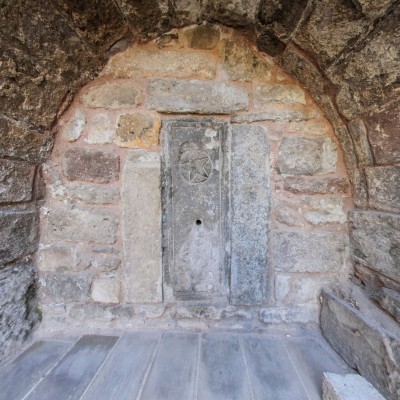
The mosque’s *mihrab* (prayer niche) and *minbar* (pulpit) are constructed of stone. The dome and roofing system are clad in lead on the exterior. Additionally, a historic fountain—no longer in use—is situated within a pointed-arched niche on the western wall of the mosque's courtyard. A six-pointed star motif, formed by the intersection of two triangles, stands out on the fountain's spout stone.
With its stone architecture dating to 1716, Ottoman-script inscriptions, domed portico (*son cemaat yeri*), distinctive minaret, stone *mihrab* and *minbar*, and the preserved older rock-cut *masjid* section, the Kara Mosque stands as a significant structure within Nevşehir's historical and architectural heritage.
Historical
Venue Features
Activities
Similar places
Similar places, nearby places, and related routes are listed here as modular panels.
01
Imaret Mosque
Karaman · Central Anatolia Region · Turkey
02
Cumayani Picnic Area
Duzce · Black Sea Region · Turkey
03
Ayvalik Cinarli Mosque
Balikesir · Marmara Region · Turkey
04
Newappetizer Mosque
Duzce · Black Sea Region · Turkey
05
Aktekke Mosque
Karaman · Central Anatolia Region · Turkey
06
Akcakoca Central Mosque
Duzce · Black Sea Region · Turkey
Nearby places
Similar places, nearby places, and related routes are listed here as modular panels.
01
Derinkuyu Underground City
Nevsehir · Central Anatolia Region · Turkey
02
Goreme Open Air Museum
Nevsehir · Central Anatolia Region · Turkey
03
Haci Bektas-i Veli Tomb
Nevsehir · Central Anatolia Region · Turkey
04
Dr. I.Sevki Atasagun Physical Therapy Hospital
Nevsehir · Central Anatolia Region · Turkey
05
Cappadocia Uchisar Castle
Nevsehir · Central Anatolia Region · Turkey
06
Cappadocia Uchisar Bazaar
Nevsehir · Central Anatolia Region · Turkey
Related routes
Travel plans that include this tour as a stop are listed here.
No matching content is available for this section.
Comments
0Sign in to leave a comment.
Sign inThe comments module is ready at the bottom. Visitor comments will appear here once the content is connected.