

 360° Virtual Tours
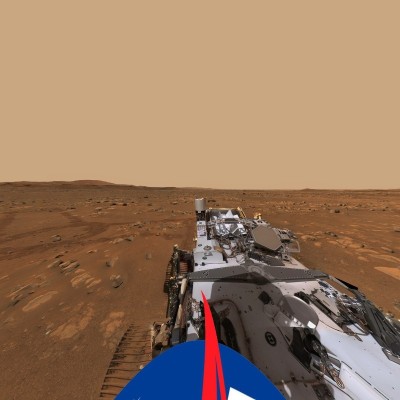
Perseverance and Van Zyl Overlook: A 360° Panorama and Real Sounds from Mars
Perseverance: The Mars 2020 Mission
Perseverance is a robotic Mars exploration rover developed as part of NASA's Mars 2020 mission. After an interplanetary journey of approximately seven months, the rover successfully landed in Jezero Crater on February 18, 2021. Perseverance's primary scientific objectives include investigating whether Mars once possessed habitable environmental conditions, searching for potential signs of ancient microbial life, studying the planet's geology and climate history, and collecting rock and soil samples that could potentially be returned to Earth by future missions. Perseverance also carries a range of scientific instruments designed to record Mars in unprecedented visual and auditory detail. These include the Mastcam-Z camera system, capable of producing high-resolution stereoscopic panoramas, as well as microphones capable of recording authentic sounds directly on the Martian surface.
Jezero Crater: Traces of an Ancient Lake
Jezero Crater, the landing region of Perseverance, is one of the most scientifically important areas on Mars because it contains strong geological evidence suggesting that liquid water existed there in the distant past. Scientists have identified evidence indicating that Jezero once contained an ancient lake and that a river flowing into the crater formed a large delta system. On Earth, river deltas are important geological environments where sediments transported by water accumulate over time and may preserve evidence of past environmental conditions. For this reason, Jezero Crater was selected as one of the primary investigation areas for determining whether Mars once possessed habitable environments and for searching for potential signs of ancient microbial life.
Van Zyl Overlook
During the early phase of its exploration of Jezero Crater, Perseverance remained at a location known as Van Zyl Overlook for 13 days. The site had a special role in the mission. While imaging and studying the surrounding Martian terrain, Perseverance was also positioned there to support and observe the first flights of the Ingenuity Mars Helicopter. The location was named in memory of Jakob van Zyl, a longtime leader at NASA's Jet Propulsion Laboratory who made significant contributions to planetary exploration. Van Zyl Overlook therefore became not only a Martian observation site, but also a historic location associated with the first controlled, powered flights ever performed on another planet.
Ingenuity: The First Powered Flight on Another Planet
Ingenuity was a small experimental helicopter transported to Mars beneath the Perseverance rover. Its primary purpose was not conventional scientific investigation, but to demonstrate that controlled, powered flight was possible in the extremely thin atmosphere of Mars. On April 19, 2021, Ingenuity successfully completed the first controlled, powered flight ever performed on another planet. During this historic flight campaign, Perseverance was positioned at Van Zyl Overlook, observing Ingenuity's activities. Van Zyl Overlook therefore holds a special place in the history of Mars exploration, both as a surface observation site and as part of the beginning of powered aviation on another world.
Mastcam-Z 360° Panorama of Van Zyl Overlook
While positioned at Van Zyl Overlook, Perseverance extensively imaged its surroundings using the rover's Mastcam-Z camera system. The work released by NASA as “Mastcam-Z's 360-degree View of ‘Van Zyl Overlook’” is not a single photograph. It is a large panoramic mosaic assembled from numerous high-resolution images. The images used to create the panorama were acquired between April 15 and April 26, 2021, corresponding to Sols 53–64 of the Perseverance mission. NASA's panoramic dataset was assembled from 992 individual Mastcam-Z images. The source panoramic dataset is described as having a total resolution of approximately 2.4 billion pixels, or approximately 2.4 gigapixels. This extraordinary level of resolution allows scientists not only to examine the overall Martian landscape, but also to study distant rocks and surface formations in considerable detail.
The Mastcam-Z Imaging System
Mastcam-Z is one of Perseverance's primary scientific imaging systems. The system consists of two cameras mounted on the rover's mast and allows the Martian surface to be imaged stereoscopically. Images of the same region obtained from two slightly different viewpoints can therefore provide information about the depth and structure of the terrain and geological features. One of Mastcam-Z's important capabilities is its zoom function. The system can capture broad panoramic views of Mars while also allowing more detailed examination of distant geological formations. Its ability to acquire images at different wavelengths also helps scientists investigate the properties of rocks, soil and other surface materials.
Real Sounds Recorded on Mars
One of the important innovations of the Perseverance mission is its ability to directly record sounds on the surface of Mars using microphones. The sound you are hearing is an authentic audio recording captured on the surface of Mars by NASA's Perseverance rover on February 22, 2021. NASA used this recording, with rover background sounds removed, in its Van Zyl Overlook 360° video presentation. The audio predates the panorama imagery and is not a synchronized recording from the exact time the panorama was captured.
Presenting the Panorama Together with Real Mars Audio
The Van Zyl Overlook panorama and the sounds recorded by Perseverance are products of the same Mars 2020 mission and the same general Jezero Crater environment. However, an important distinction must be maintained for scientific accuracy. Unless NASA explicitly confirms that a particular audio recording was captured at exactly the same location and time as the individual Mastcam-Z images used in the panorama, the audio should not be described as the “original sound of the panorama.” Audio used in the 360TR presentation is therefore identified as authentic sound recorded on the surface of Mars by Perseverance. This approach makes it possible to combine the visual and auditory experience of Mars while maintaining accurate scientific attribution and context.
Sources and Image Credits
Original imagery: NASA/JPL-Caltech/ASU/MSSS
Mission: NASA Mars 2020 – Perseverance Rover
Imaging system: Mastcam-Z
NASA panorama title: Mastcam-Z's 360-degree View of “Van Zyl Overlook”
Location: Van Zyl Overlook, Jezero Crater, Mars
Image acquisition period: 15–26 April 2021 / Sols 53–64
Source image count: 992 Mastcam-Z images
Audio recordings: NASA/JPL-Caltech – Perseverance Mars microphone recordings
Recording date: February 22, 2021
Recording platform: NASA Mars 2020 Perseverance Rover
NASA source panorama data: Approximately 2.4 billion pixels / 2.4 gigapixels
Web-accessible source image: Approximately 23,265 × 5,165 pixels
Processed panorama presented by 360TR: Approximately 450 million pixels / 450 megapixels
360° image processing, enhancement and interactive presentation: 360TR
Usage, Attribution and Technical Processing Note
The original Mars imagery used in this presentation is credited to NASA/JPL-Caltech/ASU/MSSS. Image data from the Van Zyl Overlook panorama released by NASA has been processed by 360TR for panoramic arrangement, image processing and adaptation for interactive web-based 360-degree presentation. These processes are not intended to improve, reinterpret or modify the scientific content of NASA's imagery. Their purpose is solely to prepare the available visual data for presentation within a 360-degree viewing environment. The 2.4-gigapixel figure associated with NASA's source panoramic work should not be confused with the resolution of the panorama displayed by 360TR. The processed 360° panorama presented here has a resolution of approximately 450 megapixels. Therefore, the 2.4-gigapixel figure refers to NASA's source panoramic work, while the approximately 450-megapixel figure refers to the version processed and adapted by 360TR for 360-degree presentation. Mars audio used in the presentation is selected from authentic recordings made on the Martian surface by microphones aboard NASA's Perseverance rover. Unless separately confirmed by NASA, no claim is made that these sounds were recorded at exactly the same moment as the images used to construct the panorama.
Historical
Venue Features
Activities
Similar places
Similar places, nearby places, and related routes are listed here as modular panels.
Nearby places
Similar places, nearby places, and related routes are listed here as modular panels.
Related routes
Travel plans that include this tour as a stop are listed here.
No matching content is available for this section.
Comments
0Sign in to leave a comment.
Sign inThe comments module is ready at the bottom. Visitor comments will appear here once the content is connected.